.png)


.png)
From Bore to Base: The Hidden Design Logic of Every Glass Bottle Section
mai 27, 2026
A premium spirit bottle is more than a vessel; it is a precision-engineered system where micro-millimeter adjustments dictate product safety, manufacturing throughput, and consumer prestige. The following breakdown explores the six core anatomical elements that transform a glass container into a high-performance packaging solution.
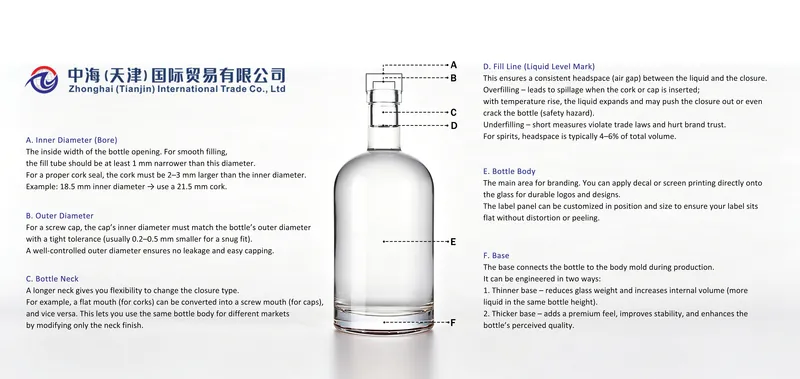
1. The Bore (Inner Diameter)
The bore is the critical interface between the liquid and the closure. Its dimensions are the foundation of shelf-life integrity.
- Filling Dynamics: To ensure high-speed automated filling without turbulence or spillage, the fill tube must maintain a 1mm clearance from the bore wall.
- Sealing Interference: For cork-sealed spirits, the industry standard mandates a 2–3mm interference fit (the cork being larger than the bore). This calibrated pressure creates an airtight hermetic seal, preventing oxidation.
- The “Glugging” Factor: Using fluid dynamics prototyping, engineers often adjust the bore by as little as 1.5mm to optimize airflow during pouring, ensuring a smooth, premium consumer experience without disruptive “glugging.”
2. Outer Diameter (Finish)
The outer diameter (finish) is the “handshake” between the bottle and the capping equipment.
- Tolerance Criticality: Modern manufacturing demands ultra-tight tolerances of ±0.2–0.5mm. Even a 0.1mm deviation can lead to torque failure, leakage, or costly downtime in high-volume capping lines.
- Automated Inspection: High-end facilities utilize Automated Optical Inspection (AOI) to verify every unit’s finish, ensuring universal compatibility with global capping standards.
3. The Bottle Neck
The neck is a strategic component that offers brands significant supply chain flexibility.
- Modular Tooling: By employing a “modular neck” design, brands can use the same bottle body while swapping the finish (e.g., from a T-cork to a screw cap). This strategy can reduce tooling investment by up to 70%.
- Ergonomics: Long necks are engineered for “speed rail” efficiency in professional bartending, while shorter, reinforced necks provide the structural integrity required to support heavy, decorative oversized closures.
4. Fill Line & Headspace
The fill line is a non-negotiable compliance and safety feature.
- Thermal Expansion: Spirits require a 4–6% headspace (air gap). Overfilling creates a hydraulic piston effect; as the liquid expands with temperature, internal pressure can force the cork out or cause a catastrophic structural failure.
- Regulatory Compliance: Precise fill lines ensure the product meets strict Weights and Measures legislation in global markets (US TTB, EU, etc.), protecting the brand from legal liability and consumer distrust.
5. The Bottle Body
The body serves as the primary canvas for brand identity and a key driver of perceived value.
- Label Precision: Engineers prioritize “label panel flatness” to prevent micro-bubbling or edge lifting. For ultra-premium brands, direct-to-glass screen printing or heat-applied decals offer a permanent, scratch-resistant alternative to paper.
- The Weight-Prestige Correlation: A 2024 neuromarketing study confirmed that bottles weighing 750g or more trigger a psychological quality cue, allowing brands to command a 15% price premium. Strategic weight distribution—concentrating mass at the base—CUSTOMIZED bottle SERVICES maximizes this effect while optimizing material costs.
6. The Base & Punt
The base balances logistical efficiency with the “premium feel” of the product.
- Base Configurations:
- Lightweight Base: Optimized for high-volume logistics, reducing carbon footprint and shipping costs per unit.
- Weighted Base (Heavy Glass): Provides a lower center of gravity and a substantial “hand-feel” that signifies luxury craftsmanship.
- Structural Integrity (The Punt): The indentation (punt) isn’t just aesthetic; it strengthens the bottle’s architecture against internal pressure and facilitates mechanical handling on the production line.
Technical Summary Table
| Component | Critical Metric | Primary Objective |
| Bore | 2–3mm Interference | Hermetic seal & flavor preservation. |
| Finish | ±0.2mm Tolerance | Capping machine compatibility & leak prevention. |
| Headspace | 4–6% Volume | Safety against thermal expansion. |
| Body Mass | ≥750g | Perceived value & premium market positioning. |
Conclusion: Exceptional spirits packaging is the result of rigorous engineering. Every dimension and tolerance is a deliberate choice made to balance manufacturing efficiency, regulatory safety, and commercial desirability. Are you developing a custom spirit bottle or struggling with line efficiency, leakage, or capping jams on your current production line? Our glass engineering specialists are ready to review your blueprints and optimize your packaging system for global compliance and peak performance.